China’s landscape lighting industry is moving beyond decorative brightness. It now combines LED efficiency, smart controls, weather resistance, and restrained architectural design. The International Energy Agency reports that lighting uses about 15% of global electricity. That figure makes every garden fixture worth examining.
This guide explores What Are The Best Lighting Ideas For Landscape Design through Chinese products, projects, and practical installation methods. We will consider warm pathway lights, recessed step fixtures, underwater LEDs, wall washers, and solar bollards. A narrow beam can reveal a bamboo stem without flooding the entire yard. A shielded fixture can illuminate stone steps while protecting nearby bedrooms from glare. Small details matter.
Randall Whitehead, a landscape-lighting designer and author, calls landscape lighting “the jewelry of the garden.” The phrase is memorable, but jewelry can become excessive. That is where many projects lose their balance. The U.S. Department of Energy’s solid-state lighting research has repeatedly identified LEDs as a major route to lower lighting energy use. However, efficiency alone does not create a comfortable landscape. Color temperature, shielding, spacing, maintenance, and local sky conditions still shape the result.
China offers useful lessons in compact manufacturing and flexible customization. Yet not every low-cost fixture deserves confidence. IP ratings, electrical safety marks, driver quality, and warranty terms require careful checking. The CIE 150 guidance on limiting obtrusive light also reminds designers to respect neighbors and night wildlife. Some recommendations in this article may need adjustment. Soil, rainfall, vegetation, and budget rarely behave exactly as expected. Good lighting leaves room for revision.
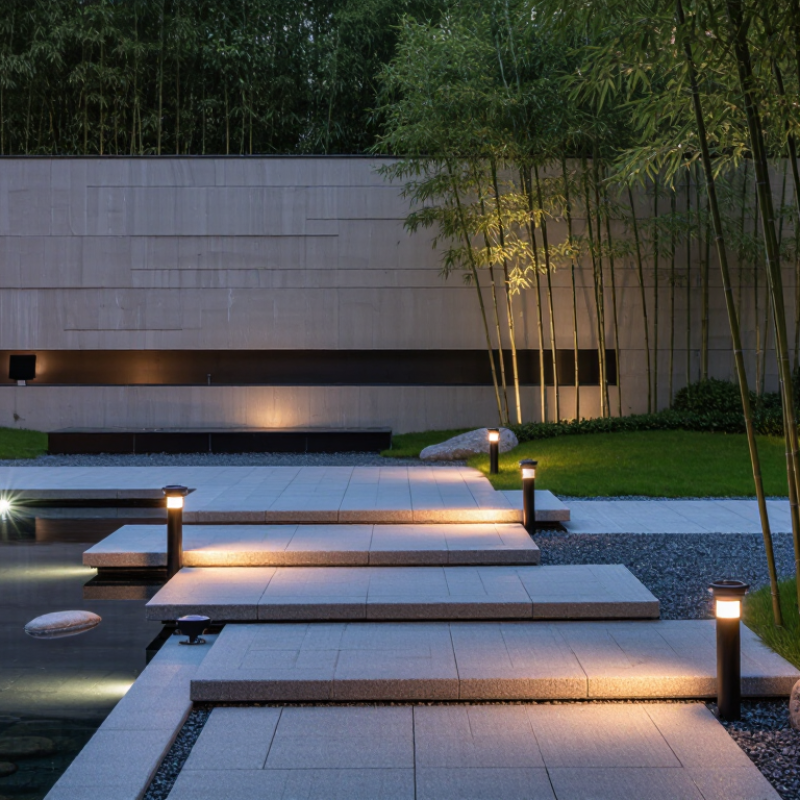
Chinese gardens rely on framed views, quiet transitions, and controlled contrast. Landscape lighting should reveal these features without flattening their mood. Path lights suit stone walkways and stepping bridges. Choose low fixtures with shielded beams. They guide movement without shining into visitors’ eyes. Warm light, around 2700–3000K, usually complements timber, rock, and planting. Keep spacing slightly irregular. Perfect rows can feel too commercial.
Moon-gate lighting creates a strong focal point. Place a narrow spotlight behind or beside the opening, not directly in front. This preserves depth and shadow. For ponds, use submerged or edge-mounted lights rated for wet locations. Aim light across the surface. A soft reflection often works better than bright glare. Accent lights can highlight bamboo, ornamental trees, and sculpted rocks. Wall-washing suits textured garden walls, but excessive brightness erases their character.
In outdoor seating areas, bollard lights can define boundaries without dominating the garden. Lantern-style fixtures add a traditional feeling, though their brightness needs careful control. In practice, layered lighting is easier to maintain than one powerful source. Timers, dimmers, and separate circuits improve flexibility. Use certified outdoor equipment, proper drainage, and weather-resistant connections. A qualified electrician should check local safety requirements. One mistake remains common: lighting every feature equally. Some dark areas are necessary. I still find this balance difficult.
What Are the Best Landscape Lighting Ideas from China?
Planning a landscape lighting layout begins with movement, not decoration. Trace the path from the gate to the entrance, patio, and garden steps. Mark dark corners, seating areas, water features, and changes in ground level. Chinese courtyard design often uses soft pools of light around bamboo, stone, timber, and framed views. Keep fixtures low and concealed where possible. This protects the calm, layered feeling of the garden.
Use warm white light near seating areas and entrances. A slightly cooler tone can reveal green foliage without flattening its color. Space path lights unevenly when the landscape feels informal. Repeated spacing may look too mechanical. Place narrow beams on textured walls, sculptural trees, or moon gates. Avoid aiming lights toward windows, neighbors, or passing drivers. Glare quickly ruins an otherwise careful layout.
Safety needs measurable choices. Select outdoor-rated fixtures, protected cable connections, and suitable low-voltage equipment. A qualified electrician should inspect the installation and follow local electrical requirements. Keep cables away from future digging zones and provide drainage around buried fixtures. Test the lighting at night before fixing every position permanently. A plan can look elegant on paper but feel harsh outdoors. I have found that fewer fixtures often create better depth, although this approach may leave small areas imperfectly dark. That darkness can feel natural, but steps and edges must remain clearly visible.
| Lighting Idea | Primary Purpose | Recommended Fixture | Typical Technical Parameters | Placement and Layout Guidance | Safety and Design Notes |
|---|---|---|---|---|---|
| Pathway Lighting | Guides pedestrians and improves visibility along walkways, steps, and garden routes. | Low-level bollard light or shielded path light | 2700–3000 K 100–300 lm per fixture IP65 or higher |
Install fixtures approximately 2.5–4 m apart. Alternate sides on narrow paths to reduce glare and create an even rhythm. | Keep the light source below eye level where possible. Avoid placing fixtures where they narrow the walking route or create trip hazards. |
| Step and Stair Lighting | Highlights changes in elevation and reduces the risk of missteps. | Recessed step light or shielded wall light | 2700–3000 K 50–150 lm per step or landing IP65 or higher |
Use consistent spacing on stair risers or illuminate each landing. Aim light downward across the tread rather than directly into the eyes. | Use low-glare optics and maintain consistent brightness between adjacent steps. Outdoor electrical connections should be weather protected. |
| Tree Uplighting | Creates vertical emphasis, depth, and a dramatic focal point for trees and large plants. | Adjustable in-ground spotlight or compact floodlight | 2700–3000 K 300–1,000 lm per fixture 15–40° beam angle IP67 recommended |
Place the fixture 0.5–2 m from the trunk, depending on tree height and canopy width. Use more than one light for broad or multi-trunk trees. | Use glare shields and avoid shining light into nearby windows. Leave space for root growth and ensure fixtures can drain properly. |
| Downlighting from Trees | Produces a natural moonlight effect for lawns, patios, and planting beds. | Small adjustable spotlight mounted in a tree or elevated structure | 2700–3000 K 200–600 lm per fixture Wide or medium beam |
Mount discreetly above the intended area and direct the beam through branches toward the ground. Overlap light gently to avoid harsh circular patches. | Use professional installation for tree-mounted equipment. Protect cables from movement, abrasion, moisture, and future tree growth. |
| Wall Washing | Emphasizes architectural surfaces and makes outdoor walls appear broader and brighter. | Linear wall washer or wide-beam spotlight | 2700–3500 K 500–1,500 lm per 3 m of wall 30–60° beam angle |
Position fixtures 0.3–1 m from the wall, depending on the required gradient and surface texture. Maintain regular spacing for uniform coverage. | Warm light is generally suitable for residential landscapes. Test textured walls at night because grazing light can exaggerate surface imperfections. |
| Facade Accent Lighting | Defines architectural features such as columns, entrances, rooflines, and textured materials. | Adjustable spotlight, linear profile, or narrow-beam floodlight | 2700–3500 K 500–2,000 lm per fixture 10–30° beam for accents |
Align fixtures with columns, vertical edges, or entrance features. Use a combination of narrow and medium beams to create hierarchy. | Avoid over-lighting the entire facade. Shield fixtures from neighboring properties and keep light directed toward the intended surface. |
| Water Feature Lighting | Highlights fountains, ponds, streams, and reflective surfaces. | Submersible spotlight or low-voltage underwater light | 2700–4000 K 100–500 lm per fixture IP68 for submerged use |
Place lights below the waterline or at the edge of the feature, aiming across moving water or toward a focal element. Keep spacing visually balanced. | Use only equipment specifically rated for the installation location. Electrical protection, grounding, and professional installation are essential around water. |
| Shrub and Planting-Bed Lighting | Adds layered illumination and reveals plant texture without overpowering the garden. | Mini spotlight, compact floodlight, or spike light | 2700–3000 K 100–400 lm per fixture 25–60° beam angle |
Place fixtures among or just outside planting beds. Use varied heights and aim across foliage to create shadows and depth. | Avoid aiming directly at viewers. Select corrosion-resistant housings and leave access for pruning, irrigation, and seasonal maintenance. |
| Patio and Seating-Area Lighting | Supports dining, conversation, and outdoor activities while creating a comfortable atmosphere. | Shielded wall light, pendant, recessed light, or low-glare downlight | 2700–3000 K 100–500 lm per fixture 50–150 lux for general use |
Layer overhead, wall, and table-level light instead of relying on one bright source. Place controls near entrances and seating areas. | Use dimming where practical. Select fixtures with comfortable glare control and avoid direct views of bright lamps from seated positions. |
| Driveway and Entrance Lighting | Improves orientation, vehicle awareness, and the visibility of doors and address markers. | Shielded bollard, wall-mounted light, or low-glare driveway marker | 2700–3000 K 150–500 lm per fixture IP65 or higher |
Use even spacing along the driveway edge and brighter emphasis near gates, doors, and changes in direction. Keep fixtures outside vehicle paths. | Avoid glare for drivers and pedestrians. Use durable, impact-resistant housings and protect cables from vehicle traffic and landscaping equipment. |
| Boundary and Security Lighting | Improves awareness around property edges without creating an overly harsh environment. | Motion-activated wall light or shielded area light | 3000–4000 K 500–1,500 lm per fixture IP65 or higher |
Cover gates, side passages, service areas, and vulnerable access points. Position sensors to detect movement without triggering constantly from public paths. | Use motion control, timers, or lower nighttime output to limit light pollution. Aim fixtures downward and avoid illuminating neighboring homes. |
| Deck and Railing Lighting | Provides discreet illumination for edges, seating areas, and changes in level. | Recessed deck light, step light, or concealed linear light | 2700–3000 K 20–100 lm per fixture IP65 or higher |
Install at regular intervals along railings, steps, or deck borders. Use concealed positions to create an indirect glow rather than visible bright points. | Use slip-resistant installation details and protect fixtures from standing water. Keep wiring concealed and accessible for future maintenance. |
| Smart Control and Zoning | Improves energy management, convenience, and flexibility for different activities. | Low-voltage control system, timer, photocell, dimmer, or motion sensor | Separate zones for paths, accents, entertaining, and security Photocell or astronomical timer Dimming where compatible |
Create scenes such as arrival, entertaining, late-night, and security. Place high-use controls in accessible locations and label circuits clearly. | Use weather-protected control enclosures. Commission the system after dark and adjust brightness to balance visibility, comfort, and energy use. |
| Low-Voltage Layout Planning | Creates a reliable system with manageable voltage drop and easier future maintenance. | 12 V or 24 V outdoor lighting system with suitable transformer | Keep total circuit load within transformer capacity Use suitable outdoor cable size Plan junctions for accessibility |
Divide large gardens into practical circuits and keep cable runs as short and balanced as possible. Leave service loops at fixtures and junction points. | Use outdoor-rated cable, sealed connections, and proper burial depth according to local electrical requirements. Final installation should comply with local codes. |
Choosing Chinese landscape lighting fixtures requires more than comparing prices.
Start with the material and the environment. Die-cast aluminum suits gardens and pathways, while 316 stainless steel performs better near saltwater. Tempered glass protects the optical chamber.
Ask for corrosion testing, gasket details, and a clear IP rating.
IP65 or IP66 helps, but poor installation can still cause failure.
Light sources need equal attention.
The International Energy Agency reports that lighting uses about 15% of global electricity. Efficient LEDs can reduce operating demand, yet efficiency alone does not create good landscape design. The U.S. Department of Energy’s Solid-State Lighting research reports show that LED performance depends on thermal management, optics, and driver quality.
Select warm white light, usually 2700K to 3000K, for stone walls, trees, and residential paths.
Use higher color rendering, preferably CRI 90 or above, where plant colors matter. Keep glare controlled.
Chinese manufacturers can offer flexible beam angles, custom housings, and low-voltage systems.
Request LM-80 or equivalent LED maintenance data, driver surge protection, and photometric files.
CIE 150:2017 provides useful guidance on limiting obtrusive light. Do not trust an attractive sample alone.
I once overlooked cable-entry details during a review.
That small mistake could have caused moisture damage. Check connectors, drainage, mounting depth, and replacement access before approving production.
Chinese-inspired landscapes use restraint, shadow, and carefully framed views. In a courtyard, light the path edge, not every plant. Place low fixtures 30–45 centimeters from walkways, aiming downward. This reduces glare and keeps wet stone textures visible. Highlight bamboo screens, rock arrangements, or a water basin from the side. Avoid pointing lights toward windows. The effect feels calmer. My first layout used too many uplights and looked theatrical.
Placement should follow walking patterns, sightlines, and maintenance access. Keep fixtures outside mowing routes, then angle beams below eye level. Use overlapping light pools at steps, with no dark gaps between treads. The Illuminating Engineering Society emphasizes visual comfort rather than maximum brightness. For efficiency, select LEDs with timers, photocells, and warm color temperatures near 2700–3000 K. The U.S. Department of Energy reports that LEDs use at least 75% less energy and last up to 25 times longer than incandescent lighting. Its solid-state lighting research also identifies controls as an important efficiency strategy. Controls are not magic. Poor settings still waste power.
Tips: Test each fixture after sunset. Check glare from seated eye level. Create separate zones for paths, trees, and water. Set late-night dimming schedules. Recheck beam angles after pruning, because changing foliage can block light quickly. Follow local electrical requirements and use qualified installers for low-voltage connections.
Landscape lighting from China often suits courtyards, terraces, garden paths, and compact urban spaces. However, climate determines whether a lighting system remains safe and attractive. In humid southern regions, inspect sealed connections after heavy rain. Moisture can enter tiny gaps and cause flickering. Use corrosion-resistant screws and raise cable joints above soil level. Clean lenses monthly, because dust mixed with rain can reduce brightness.
Cold northern climates require different maintenance. Check buried cables before winter, especially where frozen ground may shift stones. Choose fixtures with durable housings and flexible cable insulation. Snow should not cover light sensors or trap heat around lamps. In dry, windy areas, remove leaves from vents and inspect exposed wiring for cracking. Strong sunlight can also weaken plastic parts over time. Small details matter.
Upgrades should begin with a site inspection, not a shopping list. Replace damaged connectors before adding brighter lamps. Warm light usually preserves stone textures better than harsh white light. Low-voltage systems can improve control, but transformers still need dry, ventilated locations. I once placed a sensor beneath dense foliage. It reacted late every evening. That mistake was avoidable. Seasonal testing helps reveal these problems. Walk the property at night and look for glare, dark steps, and uneven spacing. Keep a simple maintenance record with dates, weather conditions, and repaired components. It may feel unnecessary. It is not.
Maintaining and Upgrading Outdoor Lighting Systems in Different Climates
IP ratings are defined by IEC 60529. The first digit indicates protection against solid particles, while the second digit indicates protection against water. For exposed landscape lighting, IP65 or higher is commonly selected; IP67 and IP68 are designed for temporary or continuous immersion. In humid, coastal, dusty, or freeze-thaw climates, regular cleaning, seal inspection, cable checks, and drainage maintenance help extend system life.
Die-cast aluminum works well in gardens, walls, and pathways. Use 316 stainless steel near saltwater. Tempered glass protects the optical chamber. Check corrosion tests, gaskets, and the IP rating before purchasing.
IP65 or IP66 offers useful protection against dust and water. However, installation quality still matters. Poor cable entries can cause moisture damage. Inspect seals, connectors, drainage, and mounting depth carefully.
Warm white light, around 2700K to 3000K, suits stone, trees, and residential paths. It creates a softer atmosphere. Avoid excessive blue-white light near seating areas. Warm light works.
Choose a CRI of 90 or higher where plant colors matter. This helps leaves, flowers, and stone appear more natural. A bright fixture can still make colors look dull. That detail is easy to overlook.
Place low fixtures about 30–45 centimeters from the walkway edge. Aim them downward, below eye level. Keep fixtures outside mowing routes and maintenance paths. Test after sunset.
Light path edges instead of illuminating every plant. Highlight bamboo screens, rocks, or a water basin from the side. Avoid aiming beams toward windows. Use shadows deliberately. My first layout used too many uplights.
Request beam-angle data, photometric files, LED maintenance records, and driver surge protection. Check replacement access and cable-entry details. An attractive sample proves very little. I once missed a small cable detail. It could have caused water damage.
Efficient LEDs can use much less energy than incandescent lamps. Use timers, photocells, separate zones, and late-night dimming. Controls need careful settings. They are not magic. Poor schedules still waste electricity.
Test every fixture after sunset. Check glare from seated eye level. Look for dark gaps between steps. Recheck beam angles after pruning, because foliage may block light. Use qualified installers for low-voltage connections.
Discover practical and elegant approaches to outdoor illumination in Chinese gardens and contemporary landscape spaces. This guide explores What Are The Best Lighting Ideas For Landscape Design, including pathways, courtyards, ponds, pavilions, planting areas, and architectural features. It explains how to balance beauty, safety, and function by layering ambient, accent, and task lighting while respecting traditional garden principles such as harmony, rhythm, and framed views.
The article also covers how to select suitable fixtures, durable materials, warm or adjustable light sources, and energy-efficient controls. Readers will learn how to position lights to reduce glare, protect plants and wildlife, and improve nighttime visibility. Installation advice focuses on secure wiring, weather resistance, drainage, and efficient power use. Finally, the guide presents practical maintenance and upgrade strategies for humid, rainy, cold, or dry climates, helping outdoor lighting systems remain attractive, reliable, and adaptable over time.

SWF Lights