How to Choose Solar Lighting for Outdoor Spaces in 2026

Time:2026-10-22 Author:Amelia
0%

Choosing outdoor lighting in 2026 requires more than comparing brightness and price. Solar fixtures now include improved photovoltaic cells, adaptive sensors, longer-lasting batteries, and adjustable color temperatures. Yet performance still depends on sunlight, weather, placement, and maintenance. A premium lamp cannot overcome deep shade beside a north-facing wall.

This guide explains How To Choose The Right Solar Lighting For Outdoor Spaces with practical, evidence-based considerations. It examines pathway lights, security floodlights, wall-mounted fixtures, garden accents, and poolside illumination. Each application needs a different balance of brightness, beam direction, runtime, durability, and visual comfort. Look for measured lumens, suitable IP ratings, replaceable batteries, and transparent warranty terms. Avoid relying on vague claims such as “all-night lighting” without testing conditions.

Small details matter. A path light may need gentle, even illumination rather than maximum output. A driveway fixture should detect movement without shining into a neighbor’s window. In winter, shorter daylight hours may reduce charging, even with efficient panels. Cloudy climates require realistic expectations.

Real installations are rarely perfect. Trees grow, panels collect dust, and sensors sometimes trigger unexpectedly. That is useful feedback. The best choice comes from observing the space at night, checking seasonal sunlight, and adjusting the layout over time. Reliable guidance should combine manufacturer specifications, recognized safety practices, and hands-on experience, while acknowledging where product testing remains limited. This approach helps create outdoor lighting that feels safe, efficient, durable, and visually balanced.
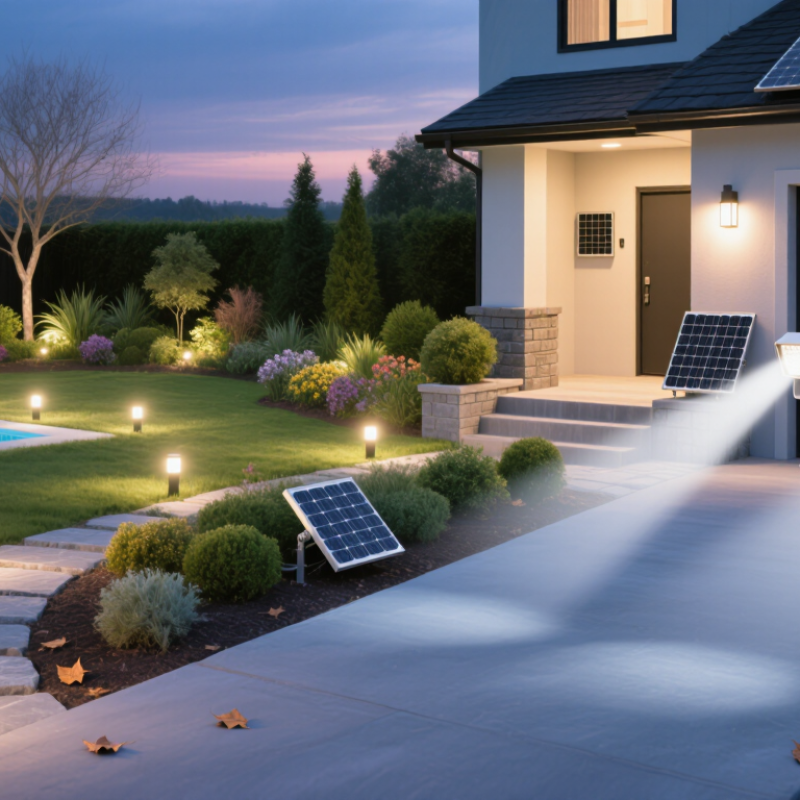
How to Choose Solar Lighting for Outdoor Spaces in 2026

Understanding Solar Lighting Technologies for Outdoor Spaces in 2026

Solar lighting in 2026 depends on more than panel size and brightness. Modern systems combine high-efficiency photovoltaic cells, LED modules, rechargeable batteries, and smart controls. Monocrystalline panels usually perform well in limited spaces. However, shaded gardens still produce weak charging results. Placement matters more than marketing claims.

Battery technology has also improved. Lithium iron phosphate batteries offer long service life, stable performance, and better thermal safety than older battery types. They still lose capacity during prolonged cold or cloudy periods. LED optics now shape light more precisely, reducing glare on windows and walkways. Motion sensors can raise brightness when people approach, then lower output to preserve energy. Useful, but not flawless.

Check the technical details before choosing a system. Look for the panel’s rated power, battery capacity, operating temperature, and lumen output. A high lumen figure means little without runtime information. For coastal or rainy locations, an appropriate ingress protection rating helps protect internal components. In my experience, poor installation causes more failures than inadequate lighting hardware. Panels need a clear view of the sky, while fixtures should avoid collecting leaves or standing water.

Smart controllers may include adaptive dimming, remote monitoring, and seasonal charging adjustments. These features can improve efficiency, but they also add electronic complexity. A simple pathway may need neither an app nor constant data. Test the light after sunset, during cloudy weather, and after several nights of use. Real conditions often challenge the specification sheet.

Assessing Outdoor Areas, Lighting Needs, and Sunlight Conditions

How to Choose Solar Lighting for Outdoor Spaces in 2026

Assessing an outdoor area should begin with movement, safety, and visual comfort. Walk the site at dusk. Mark entrances, steps, paths, seating areas, and hidden corners. A driveway needs broader coverage than a garden border. A reading area needs steadier, softer light. Avoid judging brightness from product images alone. Surface color, mounting height, and nearby walls can change the result significantly. The first estimate is rarely right.

Sunlight conditions decide whether solar lighting performs reliably. Solar resource is not the same as direct sunshine on a panel. The World Bank’s Global Solar Atlas uses long-term irradiation data, but trees, walls, dust, and winter shadows can reduce usable charging hours. Check the proposed location at morning, midday, and late afternoon. Note seasonal shade. IEA PVPS Trends 2024 reported more than 440 GW of new photovoltaic capacity globally in 2023, yet global growth cannot compensate for a shaded courtyard.

Match the fixture’s output and runtime to the area’s actual use. Review battery capacity, charging time, weather resistance, and low-temperature performance. Choose motion control only where changing brightness will not affect safety. Excessive glare can disturb residents and wildlife, so consider CIE 150:2017 guidance on obtrusive light. Leave some capacity beyond the expected demand. Real sites are messier than calculations. Recheck the layout after rain, leaf growth, and several dark evenings.

How to Choose Solar Lighting for Outdoor Spaces in 2026

Assess the activity, required brightness, and available sunlight before selecting solar outdoor lighting. The values below are indicative planning levels; local safety codes and site conditions should always take priority.

Planning guidance: Pathways generally need lower illumination, while stairs, driveways, and security areas require progressively higher levels. Install solar panels where they receive several hours of unobstructed sunlight, and account for seasonal shade, tree growth, roof orientation, and winter cloud cover.

Comparing Solar Light Types, Features, and Energy Performance

Solar lighting choices in 2026 depend less on brightness alone than on matching technology to the space. Path lights usually use small integrated panels and low-output LEDs, while floodlights need larger panels, stronger batteries, and wider beams. Decorative lanterns create softer light but may sacrifice runtime. Motion-activated security fixtures conserve stored energy, although frequent triggers can drain them quickly.

Check the battery chemistry, lumen output, panel angle, and weather rating. Lithium-based batteries generally deliver steadier performance than older rechargeable cells in cool weather, but capacity still falls during long cloudy periods. A fixture rated at 800 lumens may not maintain that output all night; verify its runtime at the stated brightness. Look for replaceable batteries and accessible controls. They extend service life. Small details matter.

Placement changes energy performance more than many buyers expect. A panel shaded by a balcony may collect little energy, even on a bright afternoon. I would test the site for one full day before installation, noting shade from trees, walls, and seasonal sun. Leave space between fixtures to avoid over-lighting. My own preference is not always the most efficient choice: warm light feels welcoming, yet cooler light can reveal steps more clearly. Solar lighting remains imperfect. Battery aging, dust, and winter darkness require realistic expectations and occasional cleaning.

How to Choose Solar Lighting for Outdoor Spaces in 2026 - Comparing Solar Light Types, Features, and Energy Performance

Typical performance ranges for residential and light commercial outdoor solar lighting. Actual results vary with location, season, shading, temperature, installation angle, and maintenance.

Outdoor Solar Lighting Comparison Guide for 2026
Solar Light Type Typical Output Typical Solar Panel Common Battery Type Typical Nightly Runtime Energy Performance Typical Protection Rating Recommended Applications Main Advantages Key Limitations
Solar Path and Garden Light 20–150 lumens per fixture 0.5–3 W; usually integrated into the top housing Rechargeable NiMH or lithium-ion; approximately 600–2,000 mAh 8–12 hours after a full sunny-day charge Very low energy demand; best for orientation and decorative illumination rather than task lighting IP44–IP65 Walkways, planting beds, borders, steps, and low-level landscape accents Simple installation, low operating energy, and wide spacing flexibility Limited brightness; small panels and batteries can perform poorly after several cloudy days
Solar Wall and Security Light 100–1,000 lumens 1–8 W; separate or integrated panel Lithium-ion or lithium iron phosphate; approximately 1,200–6,000 mAh Motion-activated models can provide several weeks of standby operation; continuous mode commonly lasts 4–10 hours High efficiency when paired with motion or dusk-to-dawn controls; standby operation substantially reduces energy use IP44–IP65 Entrances, garages, patios, side passages, and security-sensitive areas Useful on-demand lighting, adjustable detection zones, and good coverage near buildings Motion sensors may trigger unnecessarily; shaded walls can prevent adequate charging
Solar Floodlight and Area Light 300–2,000 lumens 3–20 W; separate panels are common for higher output Lithium-ion or lithium iron phosphate; approximately 2,000–12,000 mAh 3–8 hours at high output; longer when dimmed or motion-activated Good delivered light for large areas, but higher output requires a larger panel and battery to maintain reliable runtime IP65–IP66 Driveways, yards, loading areas, building exteriors, and large recreational spaces Wide illumination, adjustable aiming, and strong compatibility with motion control Requires accurate panel placement; high-power models may dim during extended low-sun periods
Solar Bollard Light 100–600 lumens per fixture 1–8 W; integrated or remotely mounted Rechargeable lithium-ion or lithium iron phosphate 6–12 hours depending on brightness and control settings Efficient for pathway and boundary guidance; optical design affects useful ground-level illumination IP44–IP65 Driveways, public paths, garden boundaries, campuses, and resort-style landscapes More visible and durable than small path lights; provides consistent fixture height Higher installation effort and cost; nearby trees or structures can shade the panel
Solar String and Festoon Light 5–20 lumens per LED bulb; commonly 50–300 lumens per string 0.5–3 W; compact external panel is typical NiMH or lithium-ion; commonly 600–2,000 mAh 6–10 hours after a full charge Low total energy consumption and suitable for ambient lighting; not intended for safety-critical illumination IP44–IP65 Patios, pergolas, balconies, events, cafés, and decorative garden structures Flexible layout, low power demand, and attractive ambient effect Low illuminance, visible cable runs, and reduced performance in shaded installations
Solar Step and Deck Light 10–100 lumens per fixture 0.3–2 W; integrated panel or remote panel NiMH or lithium-ion 8–12 hours; motion-activated versions can extend operating time Efficient for localized safety lighting because light is directed toward the walking surface IP44–IP65 Stairs, decks, retaining walls, ramps, and low-level transitions Improves step visibility with minimal energy consumption and discreet installation Small solar modules require an unobstructed view of the sky; output is usually modest
Solar Post and Lantern Light 100–800 lumens per fixture 1–10 W; integrated or top-mounted panel Lithium-ion or lithium iron phosphate 6–12 hours depending on brightness, optics, and control mode Balanced decorative and functional performance; larger batteries support more consistent evening output IP44–IP65 Gates, entrances, driveways, courtyards, and boundary posts Provides visual landmarks and broad design choices for entrances and perimeter areas Higher mounting height can reduce ground-level brightness; installation may require a stable foundation

Selection note: For dependable performance in 2026, prioritize an adequate panel-to-battery balance, replaceable batteries where possible, automatic dusk-to-dawn or motion controls, a minimum IP65 rating for exposed high-impact locations, and a color temperature of approximately 2,700–3,000 K for comfortable residential settings or 3,000–4,000 K for clearer task and security lighting.

Selecting Materials, Placement, Controls, and Weather Resistance

Outdoor solar lighting should begin with materials, not brightness claims. The U.S. Department of Energy reports that LED lighting uses at least 75% less energy than incandescent lighting and can last up to 25 times longer. Choose efficient LEDs with UV-stabilized housings, corrosion-resistant metal, sealed cable entries, and stainless fasteners. Plastic is lighter, but poorly protected plastic can become brittle under strong sunlight.

Placement decides real performance. The International Energy Agency’s Renewables 2024 report recorded almost 420 gigawatts of new solar capacity in 2023, yet small fixtures still depend heavily on local shade and winter conditions. Test each location during the afternoon. Avoid roof overhangs, dense branches, and reflective glare. Leave space between fixtures for even illumination. Dusk-to-dawn controls suit pathways, while motion sensors and dimming reduce unnecessary battery drain. I once overvalued panel size; battery temperature and shade mattered more.

Tips: Check the fixture’s IP rating for dust and water protection. IP65 is a practical starting point for exposed areas, but confirm drainage and freeze-thaw performance. Use warm light near seating areas and lower brightness beside bedrooms. Review the site after rain. Small failures often appear there. Also inspect battery access before installation; a sealed unit may look neat, but maintenance can become frustrating. Data sheets help, though they never replace an evening walk around the finished space.

Planning Installation, Maintenance, Safety, and Long-Term Value

How to Choose Solar Lighting for Outdoor Spaces in 2026

Choose fixtures according to the site, not appearance alone. Walk the area after sunset and note dark steps, tree shadows, and reflective surfaces. Check the manufacturer’s rated light output, battery capacity, weather resistance, and operating temperature.

Panels need clear access to daylight throughout the year. A south-facing position often helps, but nearby walls can create winter shade. Install lights above standing water and away from sprinkler spray. Keep cables and anchors protected. Measure twice.

I once placed a path light beneath a dense branch. It looked bright in June and failed during cloudy winter weeks. That mistake changed my planning process.

Maintenance starts with access. Wipe dust from panels every few months, especially near roads or construction sites. Inspect lenses, seals, posts, and ground anchors after storms.

Replace weak batteries with compatible types, and record the installation date. Small records prevent guesswork later. Leave room for safe servicing.

Safety requires even illumination rather than excessive brightness. Use shielded fixtures near bedrooms and property boundaries to reduce glare. Keep lights away from trip hazards, gates, and vehicle paths.

Secure loose housings before strong weather arrives. Follow local electrical and building requirements when combining solar units with wired systems.

Consider recyclable materials, replaceable parts, and expected battery life when calculating long-term value. The cheapest purchase can become expensive if the entire fixture must be discarded.

A dimmer winter setting may also protect runtime, although it can reduce visibility when visitors need it most.

FAQS

What should I check before choosing outdoor solar lighting?

Check panel power, battery capacity, lumen output, runtime, temperature range, and weather resistance. Brightness alone proves little. Read the technical details.

Where should I install the solar panel?

Choose a location with a clear view of the sky. Check it in the morning, at noon, and late afternoon. Seasonal shade matters.

Can solar lights work in a shaded garden?

They may work, but charging will be weaker. Trees, walls, dust, and winter shadows reduce usable sunlight. A large panel cannot fix every shadow.

How should I match lighting to different outdoor areas?

Use broader coverage for driveways and softer light for seating areas. Steps and entrances need consistent visibility. Garden borders usually need less output.

Are motion sensors useful for outdoor solar lights?

Motion sensors can increase brightness when someone approaches. They then reduce output and save energy. Avoid them where sudden dimming could affect safety.

Are modern rechargeable batteries reliable in cold or cloudy weather?

Long-life batteries usually perform steadily and safely. Prolonged cold or cloudy periods can still reduce capacity. Leave extra energy capacity for difficult nights.

How can I reduce glare and unwanted light?

Aim fixtures away from windows and neighboring spaces. Use precise optics and moderate brightness. A bright path is not automatically a comfortable path.

Do smart controls improve every solar lighting system?

Adaptive dimming and monitoring can improve efficiency. They also add complexity and possible maintenance. A simple path may not need an app.

How can I test whether the lighting plan works?

Walk the area after sunset and inspect steps, corners, and entrances. Test during cloudy weather and after several nights. My first estimate was not always right.

What installation mistakes commonly cause failures?

Blocked panels, leaf-covered fixtures, and standing water create problems. Keep panels open and fixtures clean. Installation quality often matters more than hardware claims.

Conclusion

Choosing outdoor solar lighting in 2026 begins with understanding how current technologies convert and store sunlight, including improvements in panel efficiency, battery capacity, LED performance, and smart controls. The best solution depends on the space, intended use, desired brightness, operating hours, and available sunlight throughout the year. Before purchasing, assess whether the area receives direct sun, partial shade, or changing seasonal exposure.

How To Choose The Right Solar Lighting For Outdoor Spaces involves comparing pathway, wall, security, accent, and area lights according to energy performance and practical features. Consider durable materials, suitable placement, weather resistance, adjustable controls, and safe installation methods. Regular cleaning, battery checks, and seasonal adjustments can help maintain reliable performance. By balancing upfront cost, maintenance requirements, lighting quality, environmental conditions, and expected service life, property owners can create attractive, efficient, and dependable outdoor lighting plans with strong long-term value.

Amelia

Amelia

Amelia is a seasoned marketing professional with a wealth of expertise in our company’s core offerings. With an unwavering passion for driving growth and innovation, she plays a pivotal role in shaping our marketing strategies and enhancing brand visibility. A key aspect of her responsibilities......