7 Tips To Improve Lighting Durability In Harsh Weather

Time:2026-10-12 Author:Sophia
0%

Harsh weather exposes weaknesses that indoor testing often misses. Salt spray reaches coastal fixtures. Dust enters poorly sealed housings. Freeze-thaw cycles slowly separate aging gaskets. This introduction to How To Improve Lighting Durability In Harsh Weather examines seven practical ways to reduce those failures.

The focus is not simply buying the strongest lamp. It includes selecting suitable IP and IK ratings, controlling heat, protecting wiring, and checking materials against ultraviolet exposure. Stainless steel, treated aluminum, and UV-stable lenses can perform better outdoors. However, material choice alone cannot prevent failure. Drainage, mounting angles, cable glands, and installation quality matter equally. A small gap around a connector can become a serious fault after months of rain.

James R. Benya, PE, a respected lighting designer and engineer, states, “Durability begins with designing for the environment, not merely selecting a powerful fixture.” That principle guides this article. It connects product testing with field experience, including inspection after storms, cleaning near roads, and replacing cracked seals before moisture spreads. No fixture is invincible. Even a well-rated product may fail when thermal expansion, corrosion, and poor maintenance combine. That is an uncomfortable point, but it deserves attention.

The following tips consider real conditions rather than ideal specifications. They explain what to inspect, what to ask manufacturers, and where installation decisions can quietly reduce service life. Some recommendations may seem obvious. They are still often overlooked. Reliability grows through repeated small decisions, not one impressive specification.
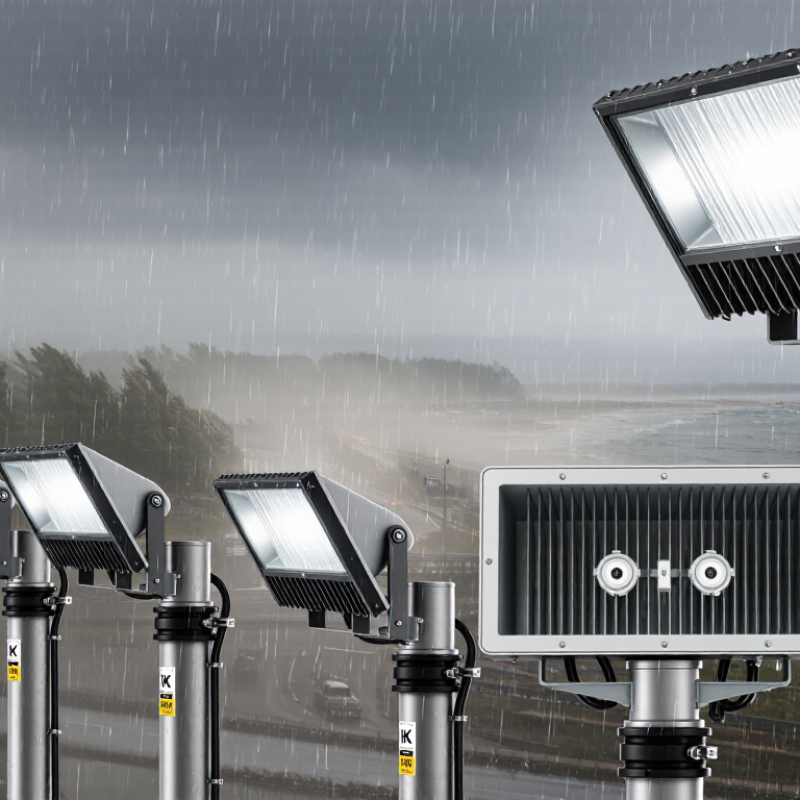
7 Tips To Improve Lighting Durability In Harsh Weather

Weather Factors That Reduce Lighting Durability

Harsh weather attacks lighting from several directions. Heat softens seals and accelerates electronic aging, while cold makes plastics brittle. The WMO State of the Global Climate 2023 report identified 2023 as the warmest year recorded, about 1.45°C above the pre-industrial average. That matters in enclosed luminaires, where trapped heat can raise internal temperatures further. Use metal heat paths, avoid blocked vents, and verify thermal performance at the hottest installation point.

Moisture is equally destructive. Condensation can form inside a fixture after a warm afternoon and a cold night. Salt spray then corrodes terminals, screws, and coatings; NOAA recorded 28 billion-dollar U.S. weather and climate disasters in 2023, showing how severe exposure is becoming. Choose suitable IP protection, add pressure-equalizing vents, and provide drainage instead of relying on a perfect seal. Use UV-resistant lenses, corrosion-resistant hardware, and flexible cable glands. Protect against wind vibration with secure mounting and strain relief. Add surge protection where lightning activity is common. Small details matter.

Field technicians often find failed fixtures with intact housings but corroded connections. That is an uncomfortable design lesson. IP ratings do not guarantee long life in salt, dust, or freeze-thaw cycles. Test samples under local temperature, humidity, UV, and spray conditions, then inspect them after installation. No checklist predicts every site. Recheck assumptions.

7 Tips to Improve Lighting Durability in Harsh Weather

Weather factors that reduce outdoor lighting durability

UV exposure, moisture, salt, temperature cycling, wind, dust and ice can accelerate fading, corrosion, seal degradation and electrical failure. Use UV-resistant materials, sealed enclosures, corrosion-resistant hardware, drainage, protective coatings and regular inspections to improve service life in severe environments.

Choosing Weather-Resistant Lighting Materials and Components

Harsh weather exposes weak lighting choices quickly. Select housings made from UV-stabilized polycarbonate, marine-grade aluminum, or corrosion-resistant stainless steel. These materials tolerate sunlight, salt mist, and repeated temperature changes better than ordinary plastics or untreated metals. Check the enclosure’s IP rating, too. IP65 may suit rain, while exposed areas may need IP66 or IP67 protection.

Gaskets matter as much as the housing. Choose silicone or EPDM seals that remain flexible during freezing nights and hot afternoons. Use stainless steel fasteners, sealed cable glands, and covered connectors to reduce corrosion paths. Tempered glass can resist impact, but it still needs a secure frame and careful drainage. Trapped water causes trouble. I once underestimated condensation inside a sealed fixture; the enclosure looked perfect, yet moisture damaged the terminals.

Protect the electrical system from surges caused by nearby lightning and unstable outdoor power. Add suitable surge protection, strain relief, and cables rated for sunlight and temperature exposure. Leave room for thermal expansion during installation. Tightening every screw excessively can distort a gasket. That mistake is easy to make. Inspect seals, mounting points, and cable entries after severe storms, then record what changed. A small crack, faded coating, or loose gland may reveal a larger durability problem before the light fails. Test materials against the actual site, including coastal air, dust, vibration, and winter ice, rather than relying only on laboratory specifications.

Strengthening Seals Against Water, Dust, and Humidity

Harsh weather usually attacks the seal before the light source. Water enters through tiny gaps around lenses, cable glands, and mounting screws. NOAA explains that air can hold about 7% more water vapor for every 1°C of warming. Repeated heating and cooling therefore increase condensation risk. IEC 60529 defines IP protection levels, but an IP rating describes testing conditions, not lifetime performance.

Tip 1: Choose a verified IP66 or IP67 enclosure for exposed locations.

Tip 2: Use compression seals that remain flexible below freezing.

Inspect the entire sealing system, not only the housing. A gasket can look intact while losing pressure after years of ultraviolet exposure.

Tip 3: Select silicone or EPDM materials with documented UV and temperature resistance.

Tip 4: Keep cable glands aligned and tightened to the specified torque.

Overtightening can deform the seal. Under-tightening leaves a hidden path for dust. The U.S. Department of Energy’s solid-state lighting reliability guidance identifies thermal stress, moisture, and contamination as major reliability concerns. Small installation errors can shorten service life.

Tip 5: Add a drip loop before each cable enters the fixture.

Tip 6: Keep drainage paths clear, even on sealed luminaires.

Tip 7: Perform seasonal inspections after storms, freezing periods, and cleaning.

Condensation needs an escape route. Look for fogging, cracked gaskets, loose fasteners, or white corrosion near joints. ISO 9223 corrosion classifications show why coastal salt exposure deserves extra attention.

One practical mistake is assuming a stronger housing fixes every problem. It does not. Seal material, installation pressure, drainage, and maintenance must work together.

Improving Installation for Wind, Heat, Cold, and Impact

7 Tips To Improve Lighting Durability In Harsh Weather

Improving Installation for Wind, Heat, Cold, and Impact

Outdoor failures often begin during installation, not inside the LED board. Anchor poles and brackets to site-specific wind loads using ASCE 7-22 calculations. Avoid generic bolt spacing. Use corrosion-resistant fasteners and isolate dissimilar metals. Torque every connection to the specified value. Seal cable entries with correctly sized glands. A tight seal matters.

Heat deserves equal attention. The U.S. Department of Energy’s LED Luminaire Lifetime report uses L70, meaning output has fallen to 70 percent of initial lumens. High junction temperatures accelerate that decline. Keep drivers shaded, preserve ventilation paths, and avoid burying fixtures in mulch. Choose UV-resistant cable jackets and flexible loops for thermal movement. Cold shrinks materials. Select gaskets that remain elastic below local design temperatures. Add drip loops to prevent ice from directing water into housings.

Impact protection needs a realistic threat model. Specify enclosure protection under IEC 60529 and verify the product’s impact rating. Polycarbonate lenses may resist accidental contact, but flying debris requires stronger planning. NOAA recorded 28 U.S. billion-dollar weather disasters in 2023. Extremes deserve attention. I have seen robust lights fail because a washer loosened or a drain hole faced upward. That error is easy to repeat. Photograph torque checks, gasket compression, and final aiming during commissioning. Inspect after the first severe storm.

7 Tips To Improve Lighting Durability In Harsh Weather – Improving Installation for Wind, Heat, Cold, and Impact
Tip Primary Weather Risk Installation Recommendation Useful Technical Data Durability Check
1. Design for wind loads Wind pressure, vibration, loosening, and uplift on poles, brackets, and surface-mounted fixtures. Use a mounting system rated for the site exposure. Fasten into structural material, use locking hardware where appropriate, and avoid relying on cladding or thin sheet metal alone. Approximate wind pressure can be estimated by q = 0.613V² N/m², where V is wind speed in m/s. Final design should follow the applicable local building and electrical codes. Inspect anchor points, brackets, pole connections, and cable glands after severe wind events and at least annually.
2. Allow for thermal expansion Heat cycling can cause stress, seal movement, lens distortion, and loosening of connections. Provide ventilation where the fixture design permits it, keep heat sinks unobstructed, and do not compress expansion joints or cable entries during installation. Typical linear thermal expansion coefficients are approximately 23 µm/m·°C for aluminum and 12 µm/m·°C for carbon steel. Actual fixture materials and operating limits must be verified. Check for cracked lenses, discolored insulation, warped housings, and darkened or heat-damaged terminals.
3. Protect against cold and freeze-thaw cycles Low temperatures can embrittle plastics, stiffen cable jackets, reduce battery performance, and create expansion damage when trapped water freezes. Select components with a specified ambient-temperature range, route cables with adequate bend radius, and prevent water from pooling inside housings or conduits. The safe operating range is product-specific. Outdoor equipment should be selected using the manufacturer’s stated minimum and maximum ambient temperatures, not a generic seasonal average. After winter, inspect seals, cable jackets, drain paths, lenses, and mounting points for cracks or frost-related movement.
4. Specify impact resistance Hail, windborne debris, tools, vehicles, and maintenance equipment can damage lenses and housings. Use a fixture with an impact rating suitable for its location, protect exposed units with guards where needed, and keep fixtures clear of vehicle paths. IK08 corresponds to a tested impact energy of 5 J, while IK10 corresponds to 20 J. The correct rating depends on the hazard and mounting location. Replace cracked lenses or housings immediately because even a small impact opening can allow water and contaminants to enter.
5. Maintain water and dust protection Rain, pressure washing, condensation, dust, and blowing sand can cause corrosion, short circuits, and optical degradation. Install cable glands correctly, keep gasket surfaces clean, tighten covers evenly, and orient drain or breather features according to the installation instructions. IP65 indicates dust-tight protection and protection against water jets; IP66 adds protection against powerful water jets. Neither rating automatically means immersion protection. Look for condensation, water marks, blocked drains, damaged gaskets, loose glands, and corrosion around entry points.
6. Reduce corrosion exposure Salt spray, de-icing chemicals, industrial pollutants, and moisture can attack housings, fasteners, connectors, and mounting structures. Choose materials and finishes suitable for the environment, separate dissimilar metals where galvanic corrosion is possible, and seal exposed cable entries. Coastal, marine, and chemical environments generally require more frequent inspection and may require corrosion-resistant fasteners and protective coatings. Remove salt and chemical deposits with a manufacturer-approved cleaning method; do not use abrasive tools that damage protective finishes.
7. Plan inspection and maintenance Small installation defects often become failures after repeated exposure to wind, temperature changes, water, and impact. Create a documented inspection schedule, record abnormal conditions, and recheck fasteners and seals after storms, construction activity, or relocation. A practical baseline is an inspection at least annually, with shorter intervals for coastal, high-wind, high-vibration, industrial, or high-impact locations. Verify illumination, protective devices, grounding continuity, enclosure condition, mounting stability, cable integrity, and signs of overheating.
Note: Environmental ratings, operating temperatures, structural loads, and installation methods must be confirmed against the applicable product documentation and local electrical, building, and safety requirements.

Maintaining and Testing Lighting Systems in Harsh Conditions

Tip 1 Inspect seals and cable entries after storms. Look for cracked gaskets, loose glands, and trapped moisture. A small water mark can signal a larger failure.

Tip 2 Clean lenses and housings regularly. Salt, dust, and road spray reduce light output and hold heat against the fixture. Use approved materials and avoid scratching optical surfaces.

Tip 3 Check brackets, bolts, and mounting points for movement. Strong wind can loosen hardware slowly. I once found a secure-looking fixture with a nearly worn mounting thread. Visual checks can miss this.

Tip 4 Test insulation resistance and grounding with qualified personnel. Follow local electrical requirements and isolate power before inspection.

Tip 5 Test lighting during both cold starts and extended operation. Record startup time, flicker, surface temperature, and output changes. A system may work briefly, then fail after heat builds. That detail matters.

Tip 6 Keep a simple maintenance log. Include weather exposure, test readings, repairs, and unusual sounds. Trends are often more useful than one perfect reading.

Tip 7 Replace damaged seals and corroded hardware promptly. Do not wait for visible failure. However, replacement decisions should consider the test results, installation conditions, and manufacturer guidance. Our earlier schedules were too general; harsh coastal sites needed shorter inspection intervals.

FAQS

How does heat reduce lighting durability?

Heat softens seals and speeds electronic aging. Enclosed fixtures can become hotter than surrounding air. Use metal heat paths and keep vents clear. Measure the hottest installation point.

What damage can cold weather cause?

Cold makes some plastics brittle and less flexible. Repeated freezing and thawing can open tiny gaps. Choose seals that stay flexible in freezing conditions. Small cracks matter.

How does condensation damage outdoor lighting?

Condensation can form after a warm afternoon and a cold night. Moisture may collect around terminals and connectors. Provide drainage and pressure-equalizing vents. A perfect seal is not always enough.

Which materials suit harsh outdoor conditions?

Use UV-stabilized polycarbonate, corrosion-resistant stainless steel, or marine-grade aluminum. These materials handle sunlight, salt mist, and temperature changes better. Untreated metals may deteriorate quickly.

Does an IP rating guarantee long service life?

No. An IP rating describes enclosure protection under specific conditions. It does not fully address salt, dust, vibration, or freeze-thaw cycles. IP65 may suit rain, while exposed areas may require IP66 or IP67. The rating is useful, but incomplete.

How can electrical connections resist corrosion?

Use sealed cable glands, covered connectors, and corrosion-resistant fasteners. Keep water away from terminals through proper drainage. Inspect connections after severe weather. Intact housings can hide corroded wiring.

How can installations resist lightning and wind?

Add suitable surge protection where lightning activity is common. Use secure mounting and strain relief against wind vibration. Choose cables rated for sunlight and temperature exposure. Loose hardware can worsen quickly.

What installation mistakes reduce lighting durability?

Over-tightening screws can distort gaskets and create leakage paths. Blocked vents can trap heat inside the fixture. Leave room for thermal expansion. I underestimated condensation once. The enclosure looked perfect, but moisture damaged the terminals.

How should weather-resistant lighting be tested?

Test samples under the site’s actual temperature, humidity, UV, dust, vibration, and spray conditions. Inspect them after installation and severe storms. Check seals, cable entries, coatings, and mounting points. No checklist predicts every site. Recheck assumptions.

Conclusion

Improving lighting durability in harsh weather requires a complete approach that considers environmental stress, product selection, installation quality, and ongoing care. How To Improve Lighting Durability In Harsh Weather begins with identifying threats such as heavy rain, humidity, dust, strong wind, extreme heat, freezing temperatures, and physical impact. Choosing corrosion-resistant materials, durable housings, reliable electrical components, and weather-rated fixtures can help systems perform consistently in demanding conditions.

Strong seals and properly fitted covers are essential for preventing water, dust, and moisture from reaching sensitive parts. Installation should also include secure mounting, protected wiring, suitable drainage, and allowances for thermal expansion and contraction. Regular inspections, cleaning, connection checks, and performance testing can reveal damage before it becomes a serious failure. By combining suitable materials, reinforced protection, careful installation, and scheduled maintenance, lighting systems can remain safer, brighter, and more dependable throughout changing and severe weather conditions.

Sophia

Sophia

Sophia is a dedicated marketing professional with an exceptional depth of knowledge about her company's products and services. With a keen understanding of market trends and customer needs, she crafts insightful blog posts that not only inform but also engage readers, enriching the company’s online......